PAINTERS
Class: Docile
Prevalence: Rare (moderate marking sightings)
Cognition: Sapient
Painters are small, rotund entities, and though they’re aesthetically animal-like, they prefer to stand and walk on their hind legs. They wear eyeless masks adorned with horns and jagged smiles [a bit similar to KB’s mask, come to think of it], have large ears that stand up straight, and their coats are marked with swooping, circular patterns opposite in color of their main tone.
Their most notable feature is their long bushy tails from which their namesake is derived. Painters have the ability to change the color of environmental void matter by painting it with the bristly end of their tail, even able to make matter luminescent or transparent. They can manipulate the “fur” of their tails into a sharp point for refined brushstrokes, or left expanded for wide coverage.
While docile, painters are exceptionally skittish and avoid contact with most humans; it’s much more common to see a painter’s markings on a tile rather than the painter itself. They’re known to leave a wide array of symbols to signify different aspects of their environment (which have yet to be fully translated, but we share the common signage of an “X” meaning “dead end” or “do not enter”). They’ll even draw long, glowing trails through a tile to indicate a safe path through.
The painters that we’ve been able to observe have shown to be a bit clumsy and scatterbrained, but they become diligent and focused when working on repainting their surroundings or drawing their doodles and symbols.
While we’ve yet to see a painter with coloring outside of the usual greyscale palette, one theory is that the bits of color seen within Somewhere may come from a specialized painter. Most of these colors show up as red, orange, yellow, and a rare bright blue, and if this theory is true, it’s further unknown if the painter would be able to access all of these colors, or specialize in just one.
WISPS
Class: Hostile and Docile
Prevalence: Rare
Cognition: Sapient
Location: Forests, Plains, Swamps(?)
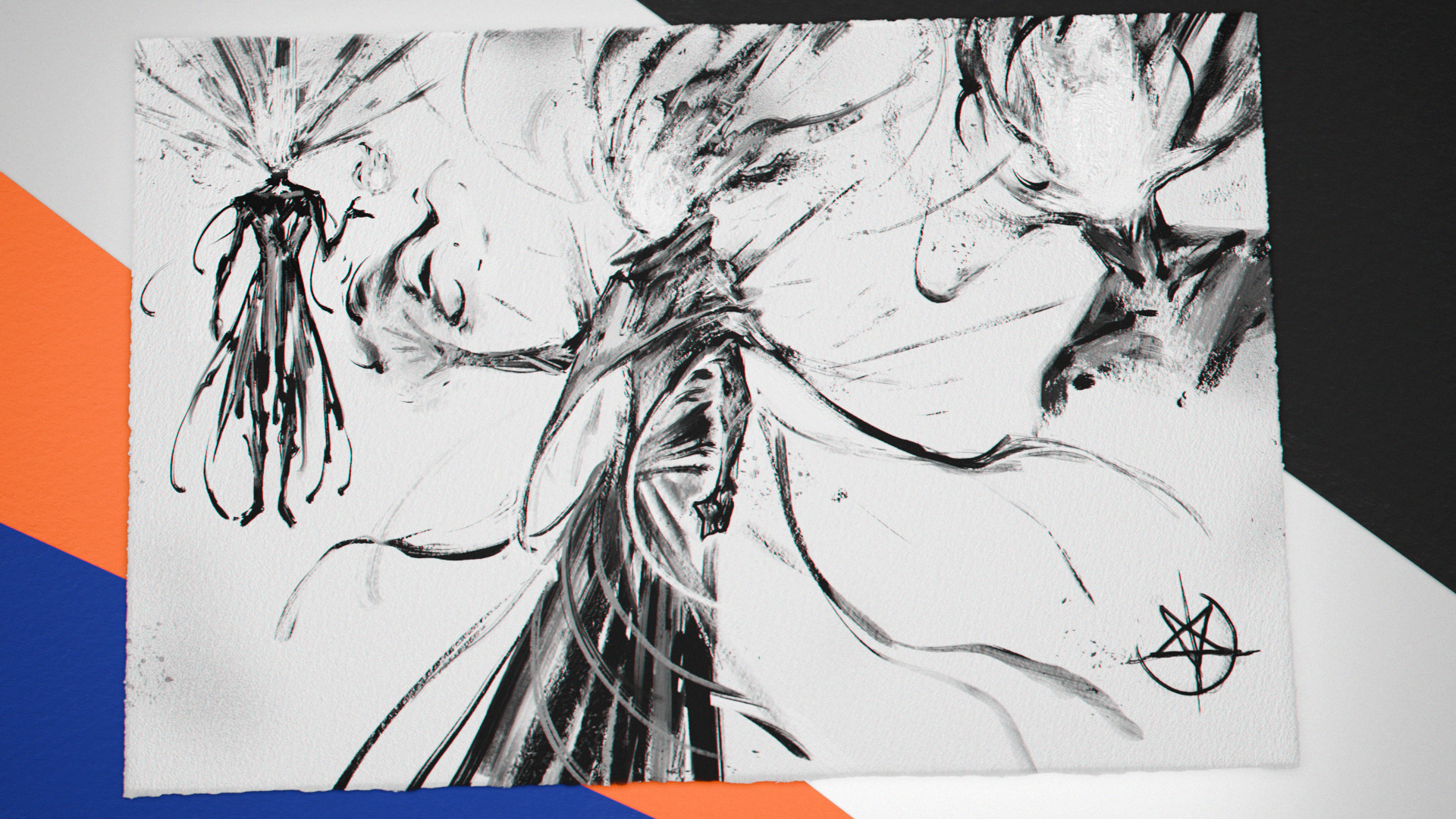
[3D render pending. This was drawn by KB in what Sam describes as an “art-slash-therapy” session. She’s made several of these and has told us about entities we’ve yet to come across, but I’d prefer to keep them out of the archive until we’ve seen them firsthand (KB’s recollections should be taken with a grain of salt, so I’ve heard.)]
Wisps are tall, humanoid entities that wear long flowing garments and have heads that are, for lack of a better term, on fire. The “fire” of the Outvoid is strange in that it seems like a kind of light-producing energy, but when brought back into our world, it dissolves into an exceptionally small drop of void matter all the same.
While unable to fly or float in place, Wisps seem to have another form of self-affecting gravity in which they can jump and leap exceptional distances with a tempered speed. They move with a smooth, elegant motion, and, if docile, act in a kind and gentle manner.
The class of a wisp can be told by the volatility of their head flames. A steady, uniform flickering and movement denotes a docile wisp, while an explosive flame denotes hostility. There is an ever-so-slight case of dimorphism that separates male and female wisps, with males having broader shoulders of the two. Both “speak” with noises that sound like a mix of bubbly synths, windchimes, and bells, with females having underlying tones of a string instrument, and males with some kind of woodwind.
To attack, a wisp will shove their hands into their head and quite literally pull the fire out from their face, lobbing it at their targets from a distance. They can only attack for so long before depleting their supply, and will need to absorb a source of fire back into themselves.
Outvoid fire, when it lands, will not spread much further from its contact point. However, if one was to be engulfed by these flames, they wouldn’t burn, but they would be immobilized by the extremely unpleasant sensation of their entire body “waking up” from falling asleep. These flames can be doused by liquid matter or smothered to be put out, but how Outvoid fire ignites naturally has yet to be seen.
If a wisp’s head is doused, their body will fall lifelessly to the the ground, and if the stump of their neck is not re-ignited within 12 hours, it will die and deconstruct into crude matter (as Fac 3 has discovered through testing. Apparently, they re-lit it the first time by dipping its neck into one of the flames it had lobbed at them before capture. Suffice to say, it was not happy when it was revived).
A small department of Facility 4 — the same one rehabilitating the injured needle dog — is in contact with a group of docile wisps in an attempt to establish a working partnership (which has proven much more fruitful than trying to work with mouths). While still in the translating stage, sending out an expedition with a wisp at the helm would offer another layer of protection and guidance through SOT.
(Lastly: one wisp was seen in the yet-confirmed swamp biome, and seemed to be right at home amongst the dozens of flickering lanterns.)
(*NOTE: Stopping here for now, forgot to upload my other notes to the archive, have to grab them from my laptop. Can’t believe how many pages we already have of these things, and who knows how many more are out there. Somewhere. Ha.)