THE HERALD
Class: Unknown
Prevalence: Unique
Cognition: Unknown (Presumed sapient)
The Herald is a unique entity that appears in the sky of Somewhere Out There before disaster hits, usually in the form of an earthquake, a structure falling, the ground opening up, object instability, and other non-entity related hazards.
It appears as a faceless humanoid male, glowing white with shifting splotches of black, surrounded by three rings covered in large eyes, the insides of which pulse with a bright light. It will flare out two pairs of eye-wings when it gestures, and when it does so, a disaster will follow within seconds. It is unknown if The Herald causes these disasters or if it's trying to warn others of the impending danger, but as soon as the entity is spotted, it's best to completely vacate the tile before its wings flare out.
A good rule of thumb: If The Herald is floating in the fetal position, you have time to evacuate. If it begins to stand up, brace yourself for imminent impact.
(Note: early reports of The Herald included disembodied hands that were then represented in the art. These hands have yet to be seen again since the first two encounters.)
HAND SPIDERS
Class: Hostile
Prevalence: Rare
Cognition: Sentient
Location: Industrial, Cities, Forests
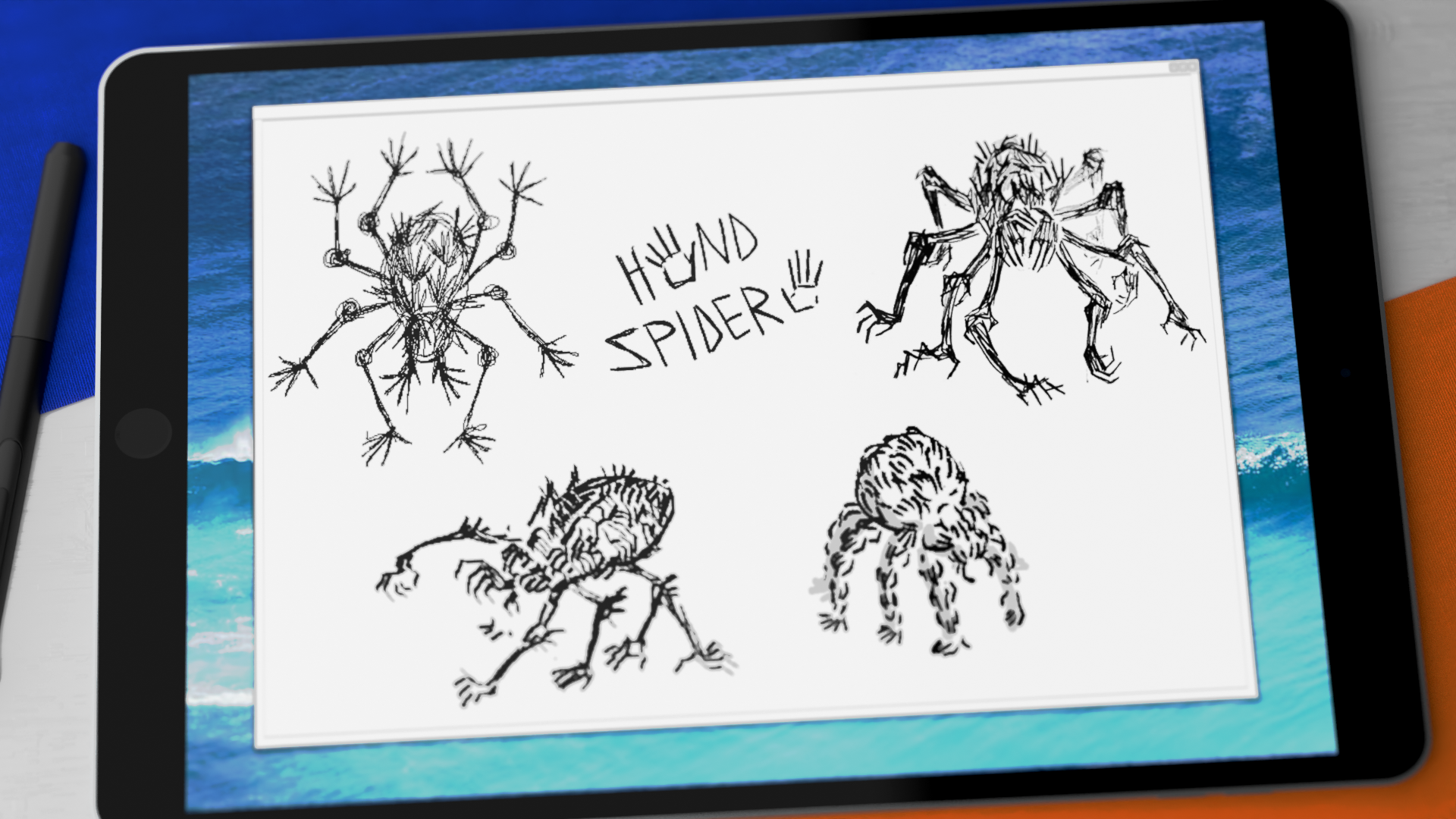
[3D render pending -- I lost where I saved the artist depictions and can't find them on the archive; will have to look for them later. I had the few people around here who've seen these things first-hand make some quick sketches as a placeholder.]
Hand spiders are, as the name may imply, spider-like entities made out of hands. These hands may be grabbing onto each other's forearms to form a structure, or the hands may be sprouting out from a solid framework of sorts. Unfortunately, hand spiders are not hand-sized, but are the size of an average adult male. They are agile, fast on their metaphorical feet, and can climb any surface at any angle, making escaping from or capturing said entity a difficult task.
Hand spiders will actively seek out any intruder that steps into their territory -- including other entities -- and will tear their victims apart with their myriad of hands. If multiple hostile entities are present in a certain area, or if an explorer is being pursued by a hostile, it's a valid strategy to try and lead them to a hand spider and hope they target the other entity instead of them. (A valid strategy, yes, but a last-ditch, desperate one.)
Like most entities discovered so far, hand spiders don't need to eat, thus their hunting seems to be purely territorial. But, like with all entities discovered so far, they do need to sleep. One spider was discovered asleep in the basement of a hollow city building, resting on a hoard of shredded bodies wrapped up in a porous, silk-like matter. The bodies themselves were reportedly mixed-up bits of shell entities yet dissolved.
The expedition was able to retreat without waking it up and evacuated the building safely, making it one of the very few run-ins with a hand spider that ended calmly and peacefully.
WEAVERS
Class: Docile
Prevalence: Moderate
Cognition: Sentient (possibly sapient)
Location: Cities, Forests, Plains
Weavers are faceless, lanky beings with twisting, noodle-like legs and multiple arms that wrap (or weave) around themselves. About the size of a two-story home -- ranging from 15-25 feet -- these entities stand out in whatever biome they're located in. They can be glowing white, solid black, or a shifting mix of the two, and while they're usually seen in groups of three, one encounter saw ten of them standing spaced out within a plains biome.
Weavers spend most of their time standing in one location and lazily swaying to and fro at a slow pace. Occasionally, they'll move a hundred or so feet to find a different location to stand. In city biomes, they'll climb up the sides of buildings to stand on the roofs, seemingly preferring the elevation to being on street level. Other entities, even hostile ones, don't seem to bother weavers (note: we've yet to see a weaver and a hand spider come across each other), making them seem more like set decoration than sentient beings.
The most cognition shown was when an employee waved at one to greet it, and it slowly lifted up two of its arms to wave back before moving positions and swaying again. The second most was when a float dog wandered by the legs of one, and it leaned over slightly to watch the dog as it walked by, slowly straightening up shortly after.
Weavers may best be classified as gentle giants, and should be respected as such.
[Update -- someone on a Fac 3 team decided to provoke one. An expedition guard popped one in the leg with his rifle at a distance, and in in response, the Weaver dropped onto its hands and knees, skittered towards the aggressor with horrifying speed for its size, and ripped them in half with one clean pull. Directly after, it slowly stood back up, walked back to its spot, and went back to its usual swaying. The bullet wound closed up like it had never even been shot in the first place, and it didn't bother to attack anyone else on the expedition.
I repeat, weavers are best classified as gentle giants, and should be respected as such.]
Blinkies
Class: Docile
Prevalence: Abundant
Cognition: Sentient
Blinkies, much like the float dog, have rather cartoonish-looking appearances. They are small creatures with spherical forms that fit in the palm of your hand, and they have a single eye that takes up a large portion of their body. They have two small antenna that jut out from the top of their heads, four thin, bendy legs that end in two small claws, and a short, up-turned tail at the rear.
They make high-pitched trilling and clicking noises to communicate, and have also been seen dancing and gesturing to each other to pass information.
Blinkies are friendly (if not slightly reckless) entities, and pose absolutely no threat to an expeditioner. The worst a blinky might do is give someone a scare as they unexpectedly latch onto them for a free ride, or be a minor nuisance as they play on them like a makeshift jungle gym.
Their most helpful attribute is the glowing white of their eye, as they can intensify and concentrate it into a beam, much like that of a flashlight. Seeing as how blinkies tend to congregate in dark environments, (and being the only recorded purely-docile entity to exist within industrial zones,) finding one can be a godsend for an expedition that's gotten themselves lost in the dark.
Unfortunately, in one instance, a blinky was brought into our world by accident. A team returned without noticing that their last member had one attached to his back, and when they opened the first airlock to the transfer room, the blinky jumped off and emitted shrill, distressed chirping noises as it ran frantically around in a circle. It flopped to the ground shortly after and rapidly deconstructed into void matter.
While this incident proved that entities could in fact be brought back to Earth, they can only exist for a few seconds at most outside of their original dimension (or perhaps a minute, given that it quietly sat through the airlock return process). I believe there's a new branch in Facility 2 dedicated to recreating the conditions of the Outvoid here on Earth to test entity/item stabilization, but that's neither here nor there for these records. Probably should delete that last line, honestly.
Anyways, for some reason, its childish name still does not bother me as much as the shrimp, though I think I would prefer if they were called something else. [Also, I've recently learned that my info was slightly off: the original nickname for the shrimp was “shramp scrampies”, which somehow makes it worse].
Watchers
Class: Unknown (avoid as if hostile for precaution)
Prevalence: Rare
Cognition: Unknown
Watchers take the shape of old box TVs with a simplified structure. They have several wires that snake out from behind them, static screens that display a variety of smiley-faces, and fingers and hands that poke out from the sides of their display. They're surrounded by three to five stylized-looking eyes that drift around the main body.
Watchers fly through the skies of Somewhere, despite lacking any obvious means to do so (which, at this point, shouldn't be surprising. Depending on how these are ordered, it’s probably been stated multiple times: things in Somewhere with no eyes can still see, and things with no mouth can still scream [sorry, couldn’t resist. Replace that with “vocalize'“]). Their many eyes will dart around, surveying the landscapes for whatever their objective is, which seems to change on a case-by-case basis.
It's unknown how or why a watcher picks its target, but when it finds it, their smiley-face screens will turn to either anger or pure static, and several sets of arms will jut out and grab the object of their attention. They'll pull it into their static, and once fully submerged, their smiley-faces will return and they'll go off into flight once more.
Watchers will only go after entities and objects that are big enough to pull into their screens. Until a watcher passes peacefully over, one should remain alert, as it's still possible to be pulled in long-ways by the larger watchers (whose screen sizes are around 40").
It's unclear what happens to the things they consume, and we've yet to come across a watcher at rest or any mass-gathering of them to more closely analyze their behavior. The only other thing to note is that sometimes, different voices and sounds can be heard cutting through their inherent white noise, as if someone was channel-hopping or changing stations on a radio.
PLANET HEADS
Class: Docile
Prevalence: Rare (moderate at Facility 2 tear)
Cognition: Sapient
Location: Barren biome chains
Planet heads are small floating creatures with lanky bodies covered by cloaks, and their planet-shaped heads hover just above their shoulders with no visible necks (the planets themselves echo our own solar system, but are not direct copies). On occasion, planet heads have been seen possessing other space-related craniums, such as asteroids or black holes [aesthetic only, thankfully].
They are the only entities noted to be native to barren biomes, and will only appear when the low-gravity phenomena happens within an expanse of linked tiles. They spend their time playing amongst the scattered debris, as well as collecting rocks to add to the innate gravitational pull that seems to encircle their heads.
It is presumed that the larger their rings are of orbiting rocks, the higher status they are amongst their kind, and groups of lesser-decorated heads will follow these leaders. However, if a shooting star event happens, planet heads will stop what they’re doing en masse and follow the direction of the stars, quickly disappearing into the darkness after them.
They've been known to show off their favorite rocks to their assumed friends, trade for others, and have also offered rocks to expedition members as a sign of trust.
As an experiment, and in a way to study them more thoroughly, Facility 2 has three barren biomes anchored in succession outside of their main barren tile. This sees planet heads “spawn” more frequently by their outpost, and by all due reports, they will hang around the crew and equipment without incident.
All in all, they are friendly and mild beings, and their existence may point to Somewhere Out There having a stronger connection to space than we once thought.
TAP-TAPS
Class: Uncategorized (almost hostile)
Prevalence: Moderate
Cognition: Sapient
Location: Cities, Industrial
Tap-taps are small creatures that stand about 2.5 feet high, wear hooded cloaks, and have elongated arms with enlarged, claw-like hands. Most notably, their heads have one visible, circular glowing eye, while a mouth of exposed teeth stretch diagonally upwards and cover where their other eye should be. This mouth opens up somewhat like a zipper, exposing a long tongue that they can use much like a frog.
Given their resemblance to planet heads (cloaked bodies, lengthy arms, simplified “bendy” legs), it’s wondered if the two species diverged from some sort of base form. But unlike planet heads — who display agreeable and calm behavior — tap-taps can be disastrously disruptive to whatever biome or person they come into contact with.
Named after the noise they make tapping their fingers against objects as they decide what to eat, tap-taps have voracious appetites that can only be sated through consuming inanimate objects. They are also the only recorded entity that displays consistent eating/hunger behaviors (outside of shells consuming food, which seems more performative rather than necessary).
Even though all of the Outvoid is made up of the same matter, tap-taps prefer to eat objects that resemble building materials, like bricks and support beams, and they seem to especially enjoy metal-like matter. A core-retrieval team reportedly watched three tap-taps devour a short, metallic foot bridge deep within an industrial building in under ten minutes. Given their small size, it’s unknown how they process such a large amount of void matter.
When hungry, tap-taps are hyperactive terrors, but when full, they will calm down and enter a much more passive state, often sleeping for extended periods of time. While not outwardly violent, they have been known to terrorize expedition groups by using their projectile tongues to steal equipment off of their belts, chew them up, and spit them out (possibly unable to fully digest these objects since they’re Earth-made).
While tap-taps won’t go out of their way to hurt humans, they can be a serious inconvenience by either altering the landscape or destroying valuable equipment. It’s best to give them a wide berth if they’re not in their passive state.
REDUCTIONS
Class: Docile
Prevalence: Abundant
Cognition: Unknown (presumed sentient)
Reductions are featureless animals that look like smoothed-over copies of what exists in our world. The majority of them look like shadows given a 3D form, while a rare few will glow with white luminescence observed in other entities. They will mimic sounds of their real-world counterparts, but always in a way that's slightly off or discordant.
Reductions have been noted in mammalian, reptilian, amphibian, avian, and aquatic forms, but so far exclude any insects, arachnids, or land-dwelling bugs in general. For the most part, a reduction will be seen in its real-world equivalent biome (deer in forests, rabbits in fields, etc), but there is one notable exception.
Aquatic reductions will always swim through the sky. Whales, sharks, jellyfish, manta rays — all types of sea life drift a few hundred feet above in the open air, and on very rare occasions, will swim near ground level. They most prominently appear in wonder biomes, but ironically enough, aquatic life (and reductions in general) have not been seen in liquid biomes (though our knowledge of what exists deep within those dark waters is still murky at best [wordplay unintentional, rewrite this]).
Shrimp scrampies are not reductions, it should be pointed out [I will also point out how much I hate that I keep bringing them up]. Though slightly confusing, all reductions are animal-like, but not all animal-like entities are reductions. Kind of a “squares are rectangles, but not all rectangles are squares” thing.
Reductions have yet to attack or even give much thought to any human or entity that comes into contact with them, but they do seem to communicate amongst themselves. If they are attacked first, they won't fight back, but will do everything in their power to escape. As an example: if a reduction finds themselves caught in any way, such as a leg clamped in a bear trap, it will tear its leg from its body and flee, with the left-behind limb melting into void matter and dissolving into its surroundings.
It will use the rest of its body mass to regrow its missing limb, but it cannot add to its own mass afterwards. All other entities’ detached parts will "decompose" similarly after a time, but their void matter won't seamlessly seep into their surroundings like a reduction's would.
And to note further: if a reduction was to have part of it chopped off and regrown over and over, the form of the animal would become more hollow and unstable until it can no longer move. It will reach a death of sorts, in which it will dissolve entirely.
They also don't exhibit normal predator-prey interactions, coexisting peacefully with each other despite their perceived species, making their injuries and deaths solely afflicted by outside forces. They retain certain inherent characteristics, such as herbivories miming grazing behavior, but otherwise, reductions act as set dressing to whatever biome they find themselves in.