(!BACKUP COPY, out-of-date.)
Summarizing information from facility records in regards to the animate lifeforms found within Somewhere Out There. This whole document is a bit editorial on my part, but I’ll let whoever’s filtering this for the main facility’s archives make it more clinical if they want. Refer to Stevenson's notes for more precise data, and consider my notes to be more informal flavor text to go along with it.
The images provided are both drawings derived from first-hand encounters with these entities, as well as 3D renders based on telemetry received from stasis rings.
Also, to future me: when you're lifting this info for the onboarding site, make sure you delete any frivolous remarks and sanitize the more violent aspects of these entries. Get across that hostile entities should be avoided, but we shouldn't scare the new guys with the specifics so soon.
Nevertheless, let’s get into it. For confirmation and accountability, this document is being written and maintained by L. Benford from Facility 4. List isn't definitive and will be updated when applicable.
ENTITY ARCHIVE
Before specific details, some sweeping generalizations of the entities below:
- Entities are often faceless, or lacking a primary facial feature (If they have eyes, they may not have a mouth. If they have a mouth, they may not have eyes. Etc). This seems to be purely aesthetic and does not hinder their actual senses.
- Entities do not speak any known Earthly language. The outcasts can speak English (and one reportedly speaks French), but outcasts, including KB, are not included in this list and are classified separately.
- Most entities do not need to eat, but they do need to sleep. Any hunting done by hostile entities seems to be out of territorial aggression or for fun.
- Entities tend to be made up of stark white and pitch black void matter. The white material often exudes its own bioluminescence, and the black material will either be slick and shiny or hardened like a shell of plastic. Very rarely will you find entities with fuzzy/furry textures or matte material, and very rarely will you find them with a middle-grey appearance.
- Certain clothes entities wear have been seen with a constant flickering, almost fire-like effect at the hems. As most entities lack regenerative abilities, this effect is caused by void matter presenting at differing transparencies.
- Humanoid entities are mannequin-esque in appearance, with finer anatomy details smoothed over or not existing at all. This goes for things such as fingernails, hair, reproductive organs, and musculature. Their inner-anatomy varies wildly from being to being, as some have rudimentary skeletal structures covered in thick layers of void matter, while others are completely hollowed-out shells.
- Reproduction of entities is currently unknown. We can assume the Void cast some quantity of them into the Outvoid as a start, but if/how they multiplied or evolved thereafter is undocumented.
- All entities (sans certain unique ones) have a chance to be found in "wonder" biomes, even if the conditions within do not match their usual habitats. This can cause equally intriguing and horrifying situations for both OEA expeditions and entities that could not happen elsewhere.
Information is presented as:
NAME
Class: [Hostile] [Docile] [Unknown]
Prevalence: [Unique] [Rare] [Moderate] [Abundant]
Cognition: [Sentient] [Sapient] [Unknown]
Location: [specified for unique entities, categorized by biomes if possible, otherwise left out if unsure or if there’s a widely-dispersed population across Somewhere.]
(Note: Unique entities may not actually be unique, only categorized as such if two of them have not been seen in the same place at the same time. However, entities tagged unique should still be considered the only one of their kind until proven otherwise. Just trying to cover all my bases here.)
MOUTHS
Class: Hostile
Prevalence: Rare
Cognition: Sapient
Location: Cities, Industrial, Forests
Mouths, occasionally referred to as jaws, maws, or other teeth-related names, are one of the most aggressive entities we’ve found within Somewhere. When standing high on their tendrilled legs, they can easily reach seven to eight feet in height. They often don chains and skulls on top of their cloth-wrapped outfits, though whether these skulls are native to Somewhere or trophies taken from previous expedition members is currently unknown.
Mouths are known to attack humans on a whim, speak in a language yet deciphered, and have shown exceptional cunning and intelligence in setting up traps and ambushing expeditions. Thankfully, mouths tend to be solitary hunters, and while one has yet to be confirmed killed by our weaponry, they will retreat if hit by enough firepower. (This goes for all hostile entities: gunfire is a deterrent, not a solution. Notion repeated in the needle dog entry.)
But in one grim encounter, a mouth was successfully bargained with. While we can’t understand their language, they appear to understand ours, and one Fac 3 expedition was able to trade one person’s life for the rest of the group’s safety [Assumedly, at least, as the group never actually confirmed their death. They shoved the chosen person towards the entity and immediately hightailed it back to base. All that was heard from their audio recordings was a desperate flurry of swears that grew quieter with distance. Please note: OEA does not officially condone sacrificing your teammates unless absolutely necessary.]
However, we can make an educated guess on what may have happened to them. On two separate occasions, mouths have been seen performing autopsies on human victims, studying our skeletal structures and removing organs to preserve. We assume they have taken an interest in us as much as we've taken an interest in those of their world, and their actions serve as a morbid mirror to our own studies. Unfortunately, any attempt at a peaceful exchange of information with mouths has ended in failure; they don't seem keen to work with us without bloodshed.
Locking down our current mouth specimen cost the lives of four guards, and in some probably frowned-upon display of dominance, its stasis ring isn’t being held in storage, but is displayed at the exit of Facility 2’s outpost tile -- a scarecrow to deter other hostile entities from coming closer.
« An extra render depicting a weeper in a decorated liquid biome.
WEEPERS
Class: Docile
Prevalence: Rare
Cognition: Sapient
Location: Any biome with fog/mist weather phenomena
Weepers are distressed humanoids that appear in the mists. You will always hear them before you see them, as their wails and sobs permeate through even the thickest fog in about a half-mile radius around them.
Weepers often take the form of glowing women draped in heavy, black blankets or fabric, though male weepers have been reported in three cases (two visually identified, one only heard). Several extra, ghost-like arms hover around them, sometimes seen hugging the weeper in self-comfort, covering their eyes, or clawing at the ground around them. Halos have been seen over a few of their heads, but the circumstances needed for these halos to appear is unknown.
They aren’t hostile by nature and will not attack expeditioners, but they are solitary entities that don’t like to be disturbed or approached. If someone steps too close to them, the weeper will stop their crying to shriek like a banshee, causing a fierce wind to push back anyone around them, and they will vanish into the mist shortly after.
There have only been two known cases of a weeper not lashing out to human contact. The first was with a short-term employee who approached one despite the protests of her group, who then refused to leave its side, saying that it was calling to her for help. Her team desperately tried to get her to come back, but soon the fog overtook them both and forced the remaining expedition to flee before they were lost in it as well. Her tablet was never recovered, and we only have the testimony of the survivors.
The second became our current stasis subject. It had materialized at the edge of one of our anchors, where the fog had built up at the edge but not passed through, allowing us to observe it with relative ease. One of our employees approached it to test if their shriek-wind would permeate the anchor’s barrier, but to everyone’s shock, it didn’t react negatively. Instead, the weeper seemed to acknowledge him as he spoke, lifting its featureless face to watch him silently, its crying subsiding for a time.
Thankfully he had a stasis ring on him, and was able to secure the weeper. According to him, he told it that the device would make its suffering stop for a while. Now, whether or not it knew it was going to be placed in suspended animation, I have no idea, but we do know these entities go into a sleep of sorts during stasis, so at least he didn’t lie entirely.
When it was locked down and subsequently moved into a storage area within the anchor zone, the fog it had once been in subsided, perhaps linking these entities to the mist phenomena more than just materializing within it.
Float Dogs
Class: Docile
Prevalence: Moderate
Cognition: Sentient
Float dogs have the appearance of small, cartoonish, stuffed animal-like dogs whose bodies are constantly, to some degree, wobbling or moving in a wave-like motion. This appears to intensify with their level of distress, but a happy, content float dog will show very little signs of extra motion beyond their luminescent aura. The collars they wear don’t seem to be a part of their physiology, but they can’t be removed either, and are subjected to the same wobbling as the rest of the entity.
Float dogs cannot vocalize beyond muffled "bwoauf" noises, do not blink, and as one of my colleagues put it, “look like they don’t have a single thought behind those eyes”. When they sleep, their eyes retract into their heads completely, only to pop back out with a literal “pop!” noise when they wake. They haven’t shown any signs of needing to eat, but one was offered a piece of a granola bar by an expedition employee (who had it in his utility belt, for some reason), and the dog just shoved its face into it and absorbed the bar. Its tail wagged afterwards and no adverse symptoms were noted.
Float dogs, much like the canines of our world, are exceptionally friendly, social creatures, often travel in small packs, and can give expedition teams a much-needed morale boost when encountered. They have even been reported to walk alongside the expeditions for some time, only stopping at what’s theorized to be the edge of their territory or tile. However, If they feel threatened, they will group together and shimmer fiercely to deter the perceived threat. If all else fails, the float dog relies on its namesake.
If they are suddenly frightened or otherwise out of options to defend themselves, the float dogs will simply float up and away. If it’s in defense, they can launch themselves with surprising force. If it’s from being snuck up on and scared, they will slowly float up like a helium balloon on its last legs. They have also been observed jumping from great heights and lazily drifting downward, landing completely unharmed.
According to first hand accounts, in their floating state, these dogs are almost weightless and able to be compressed to an astonishing degree with seemingly nothing inside of them, like a somewhat-deflated balloon. But, in their normal state, they are rather heavy for their small size and solidly-built. Their ability to change between these states at will is yet to be understood.
Ex: one expedition team reported playing “keep up” with a float dog, gently bouncing it back and forth in the air, until it decided to change its weight and fall to the ground. The float dog was unharmed and showed no signs of distress.
Float dogs are one of the highest-priority entitles that Fac 2 wants to try to bring into our world and stabilize, given their small size, good nature, and trust of humans. However, no sane person really wants to see a float dog melt before their eyes if we haven’t figured out a sure-proof stabilization method yet (see "blinkies" for adjacent info).
Shrimp Scrampi
Class: Docile
Prevalence: Rare
Cognition: Sentient
Location: Liquid Biomes
Shrimp scrampies, much to my chagrin, were found and jokingly named by the A12 expedition as a placeholder, and the name stuck (a mix of “shrimp scampi” and “scram”, for how they first skittered away when approached by humans, apparently). I don't know why it bothers me so much, but it does. I'm just going to call them shrimp.
The shrimp of the Outvoid mirror the shrimp of our world, but are notably missing their hind swimmerets. They're about 4-6 inches long, found predominantly in liquid biomes in groups of ~one hundred strong, are able to float slightly, and swarm like birds do in a murmuration. A lone shrimp being spotted in another biome is a good indicator that a liquid biome is imminent, as some shrimp may wander from the group, but they never stray too far from their origin.
They'll scatter if approached too closely, sometimes diving into the water near them, but a brave few have been noted to pinch at the boots of expeditioners.
Not much to say, elsewise. I don't hate the little guys myself, I just hate the name. To be honest, most of our entity names are rather short and on-the-nose, but I just can't get past "scrampi".
THE PRISONER
Class: Unknown
Prevalance: Unique
Cognition: Unknown
Location: Unique Liquid
The Prisoner is a unique entity found within an unordinarily shallow, stabilized liquid biome located off of Facility 1's tear. It's a glowing humanoid submerged up to the mid-thigh in flowing water, wrapped in barbed wire, draped in cloth, and stabbed through several times with swords, with more blades floating around its head in an arc.
The Prisoner is cuffed at the wrist with chains leading up into a blackened sky with no obvious point of attachment. It doesn't move, it doesn't speak, it just stands there with it's arms wide open, as if waiting to be embraced by something. Locking it down with a stasis ring has been deemed unnecessary, and had it not been for its shallow breathing, it would've been written off as another one of Somewhere's odd decorations.
The only major activity documented was when an employee went to remove a sword from the prisoner's chest, in which one of many giant, mechanical tendrils arose from behind it and violently smacked the employee away, breaking 2 of their ribs in the process. When another team member reached out for the handle, the tendrils flared in warning, only settling once the employee moved away.
For what purpose or punishment The Prisoner stands, we've yet to figure out, but removing the swords may be the key to it regaining its mobility. Whether that would lead to our betterment or detriment is anyone's guess.
[Also, I apologize for how many times I will write “currently unknown” or “yet to be understood” or any variation of the phrase. There truly is so much we don’t know, even with over two years of studies and field work.]
NEEDLE DOGS
Class: Hostile
Prevalence: Moderate
Cognition: Sentient
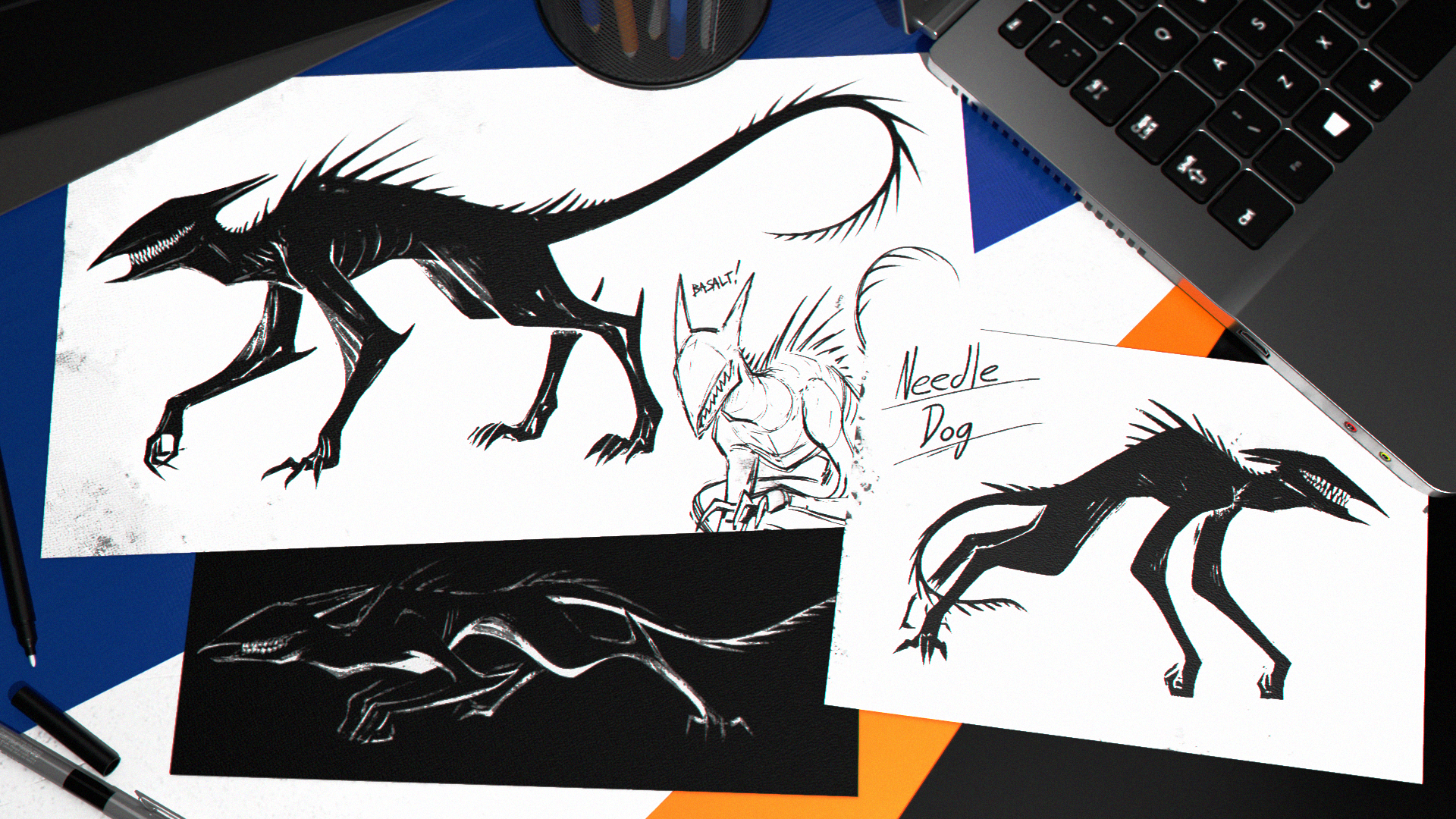
[3D render pending]
Needle dogs, unlike their cuddly canine counterpart [remove the alliteration] float dogs, are highly-aggressive pack hunters that travel in groups of four to five. If a lone needle dog is seen, it's safe to assume at least three more are waiting in ambush.
Needle dogs are named for the needle-like protrusions that emerge from their arched spines, sporadically appearing from the napes of their elongated necks to the tips of their tails. These needles are able to be launched out as projectiles with extreme precision, and next to their ferocious bites, are their main form of attack and defense.
Their heads, while vaguely dog-like, are smoothed over with pointed protrusions on the nose and chin. They have jaws of visible sharp teeth that extend to the back of their skull, but have no discernable eyes. Their hind legs are similar to other quadrupeds, but their front limbs are much more reminiscent of human arms. Usually, they'll have a thin membrane that stretches between their forearms to their shoulders, as well as from their knees to their hips.
On average, needle dogs seem to be just over the size of a Great Dane and of a similar weight, but about twice as long when counting their tails. Unlike other non-unique entities that tend to be uniform throughout their species, needle dogs can have notable differences between them. One pack member could be gaunt with bowed legs and lowered hind quarters, while another could be heavyset and wide with no limb membranes.
The noises they make sound like a cross between the snarl of a tiger and the growl of an alligator. Their noises expressing contentment sound similar to noises emitted in agitation, making their body language an important read in determining their mood [and more importantly, if Basalt is going to bite your hand off or not].
Our current specimen [the aforementioned Basalt] came from an abnormal encounter. An expedition stumbled upon a lone needle dog with visibly maimed legs, who reportedly, was "whining like an injured dog that smoked two packs a day, and pitifully trying to stand up". The team assumed it was a setup for an ambush and were about to vacate, but one member decided against the order and approached the needle dog instead.
It didn't try to attack, and it instead cowered at their approach. The employee was even able to place a hand on its head without it snapping, and thereafter secured it in a stasis ring.
It's theorized that either its pack left it when it became injured, or the pack sensed its lack of inherent aggression, and so, aiming to cull the weakness from their group — purposefully injured it, leaving it to die.
Work is being done to mend its legs alongside taming it. If possible, being able to bring needle dogs on expeditions would provide a much better line of defense for our employees, as our firearms only act as a deterrent to hostiles. Most entity deaths within Somewhere Out There are at the hands of other entities [if you don’t count Fac 3’s stasis ring vivisections and reduction experiments].
THE SILENT PRIEST
Class: Docile(?)
Prevalence: Unique
Cognition: Sapient
Location: Cities primarily
The Silent Priest is a half-skeletal entity wrapped in chains, wearing a cloak decorated with black roses and spikes, and dons a halo-like crown on its head. It's missing the top half of its skull, and a crescent moon floats within the darkness left in its place.
The priest gets its name from the way it holds its folded hands, and though shown to be intelligent, it does not speak. While the priest has been spotted in several locations, it's most often seen in city biomes, and most unnerving of all, it always appears in the distance from the initial observer, or just in the periphery of their vision.
It's unknown what The Silent Priest's goals are, but it has never acted hostile towards any expedition. In fact, in one documented case, expedition B19 lost track of the anchor path on the cusp of the 24-hour shift mark. If they did not make it back to an anchor, they would be transported along with whatever tile they were on to a new location, making their return to Earth highly improbable [or more likely, statistically impossible].
In the middle of the team's frantic arguing, one member spotted the priest watching them at the end of a stretch of city road. It beckoned them to come forward, and out of options (or out of desperation), the expedition caught up to it and followed it.
It calmly lead them back to the anchor path three tiles over, and though the team tried to ask it questions, it only waved them off with its hand and never spoke. The team had just made it safely into the anchor bubble as the environment began to shift. One employee thanked it for its help, and it folded its hands and bowed in response, only to vanish along with its surroundings and be replaced with a forest biome.
Since that encounter, expeditions have considered seeing the The Silent Priest as a sign of good luck, but it's still advised to not approach it unless absolutely necessary, as its motives remain unknown. It could be helpful in one situation and dangerous in the next until proven otherwise.
The Silent Priest's appearance being a not-so-uncommon phenomena around Facility 2's tear does pose two theories: that it's not a unique entity and there are several like it, or even if Somewhere is infinite, certain tiles shift in a set location around themselves, allowing for tiles and entities to remain semi-constant in an area.
SHELLS
Class: Docile and Hostile
Prevalence: Abundant
Cognition: Sentient (possibly sapient)
Location: Cities primarily
« An extra render depicting a floating shell within a wonder biome (accented with industrial-barren details).
Shells are exceptionally human-like yet featureless entities that tend to populate city biomes, but have been spotted elsewhere on the rare occasion. They've been seen with the usual color variations of glowing white, polished black, or a shifting mix of both, but can also have a clear body seemingly shaped out of swirling smoke. This, however, is just an illusion. The bodies of these shells are completely solid; their void matter is merely showing in its most translucent state, mixed with glowing white matter in a way that appears like vapor or smoke.
Shells seem to mimic the behaviors of humans in cities. They'll walk on sidewalks, lounge inside of homes and lobbies, even "talk" to one another without audible sounds or words. They also have been seen consuming the fake food and drinks that sometimes manifest inside of buildings, even without the use of a visible mouth.
While arguably sapient, long-form communication with shells has been difficult. For lack of a better term, they seem to be more akin to NPCs in a video game rather than deep-thinking individuals. They'll react to what we say by showing exaggerated movements and physical acting to make up for their lack of voice, but in every occasion, they'll eventually, and abruptly, return to what they were doing on a cycle.
If interacted with again, asking the same questions or saying the same things will garner a near-identical response to how the shell originally reacted. They have been shown to give helpful responses though, such as pointing in a direction if asked where a certain biome is, as well as intelligent inferences, such as holding up fingers when shown a number of objects and asked how many there are.
But there are exceptions to this mild behavior. While rare, certain shells have been known to become enraged at the presence of expedition teams and attack them on sight, using their bare hands or improvised weapons to do so. The docile shells won't react to their outbursts, even if a hostile one knocks them over to get to their target. The docile shell will simply stand up and return to whatever it was doing, barely inconvenienced.
These shells are perhaps the weakest of the hostile entities however, and a rifle round or two is enough to scare them off. However, they can still inflict serious damage (usually by bludgeoning in some way) if an expedition team doesn't have a guard to protect them.
Shells seen outside of city biomes are known to float above the ground, while their city-based counterparts firmly abide by the laws of gravity. It's still unknown how or why the biome they're in changes their personal gravitation.
It's also currently theorized that some of the more human-like entities (such as weepers and various unique beings) are shells that have evolved in some way beyond their limited capacity for interaction. But as they stand, the purpose of a shell seems to mimic that of a reduction (see "reduction" entry) in which they possibly serve as set decoration to fill out or give artificial life to Somewhere.